If you found my web site useful consider making a donation through Pay Pal.
Thanks!

|
|

Custom Search
Gracias a coinmill.com


Dominican Republic Beach, Telephone and Dengue Survival Helps
Home | Dining & Night Life | Hotel | Sights | Pictures | Music | Colonial Zone Map | Hot Spots! Directory | Site Search
site map Copyright © 2005 - 2016 All Rights Reserved. Colonial Zone-Dominican Republic (DR)
Our complete exchange rate tool.
Home | Calendar | Night Life/Dining | Sight Seeing | Pictures | Businesses | Artists | Food | Helps | History | Language | Music | Media | Pastimes | Products | Tradition/Legend | Links | About Us | Buy Mamajuana | News Blog | DR Gringa's Life Blog | Dominican Dog Blog | Web Designer
I strongly suggest you try and learn a little Spanish before you arrive. It is not essential but it does help. We have many language pages for you to learn a little Dominican Spanish or click on the ad on the left for a great language program. Try to learn the basics of Spanish. Give that brain some exercise and it can also help you know what is happening around you, even if it is only understanding a few words. It could really help you if there is a problem and the Dominicans will respect you for trying, even if you only know a few words.
Helps and Puddles - Page 4

Travel Information (UK, USA, Canada) | Basic Helps | Driving & Public Transportation | Money | Tipping and More | At The Beach | Telephone | Dengue and Chikungunya Virus | Going Out | Drinking |
At The Beach/ Playa
Be prepared to be bothered by vendors. Hair braiders. Massage girls. People selling sun glasses and jewelry. Food (do try the seafood that passes by if you like it. The clams are yummy!) vendors. You will be hounded. They might not bother you much if you just ignore them. Don't make eye contact if you don't want to buy anything! Sometimes this helps. Don't let it ruin your stay. Just try and enjoy it as another part of Dominican flavor.
Buying your drink in the Colmados (the little corner store where the locals congregate) or the grocery store is the cheapest way to go. Buy a bottle of rum and just get the ice and mixers from the "chair guy" if your looking to save a buck. Beer is good to purchase at the Colmados also but it gets warm so fast for me its just better to spend the extra and get it from wherever you sit to make sure its good and cold (bien fria)
If you do sit in a bar or outside establishment keep track of how many drinks you have (I keep a label collection-rip a piece of the label for each beer you have and keep them for a liquid count).
+click to enlarge
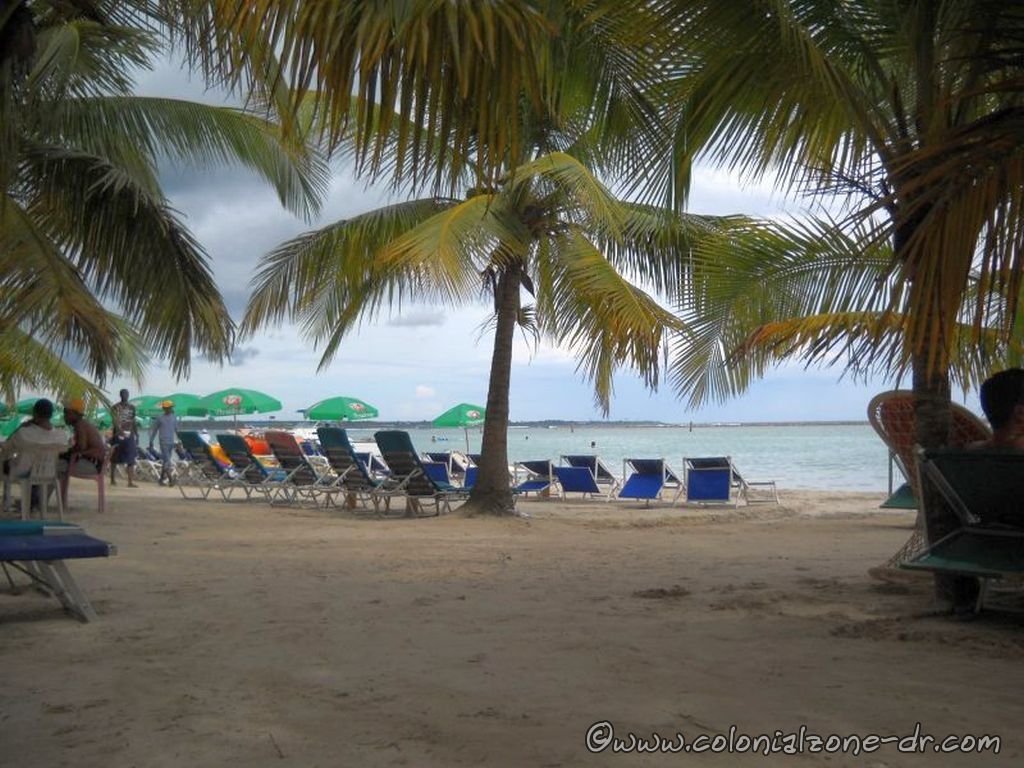
Chairs at Playa Boca Chica
Remember that when meeting people of the opposite sex, especially on the beach or in tourist areas, that many people are not just being friendly. There are many prostitutes here of all ages looking to make some cash. For the women these men, the Dominican version of a gigolo, are called Sanky Pankys. For men they are just prostitutes. It is easy to fall in love with these people. They look great, dance even better and tell you just what you want to hear. Be cautious. If you decide to be with these pay for pleasure people do not fall in love. Remember you must pay for their services even if they take you home to meet their families. Many times they will tell you that their mother is very sick and they need money for medicine or some other con. All i can say is enjoy if you choose this type of service and be very cautious. USE PROTECTION of your heart, money and use condoms. Also check ID's to make sure that they are not underage as this could get you into some big trouble. Remember prostitution in Dominican Republic is not legal even though it is quite open and easy to find.
Do be careful of the mosquitoes. They have been known cases to carry dengue, chikungunya and malaria (more information further down this page). Where there is a breeze, ie. on the beaches or near the water, this is usually not a problem. But inland be cautious. The no seeums (more about no seeums) are treacherous in the country areas and can leave red blotches on the skin for weeks. The bites usually don't itch after the first day or so but they do look really ugly. Use a strong DEET bug spray if you encounter these pests.
The Dominican sun is very HOT. Use sun screen and put it on the body often. You know..after swimming and when sweating. Most Dominicans do not sit in the sun. They use the umbrellas or find a shady spot. This is a very good idea. You do not want to ruin your vacation with a nasty sunburn.
Keep hydrated. Drinking beer and rum on the beach is a given. Just make sure that you also drink sufficient amounts of water, water and more water.
It is fun to try different foods from the vendors on the beaches. The clams and oysters are great. Get a coconut (coco) and drink it down. Buy a little red coconut candy from the kids selling them. Make sure to ask the price ahead and make them stick to that price. Many will tell you one price before you buy then when you have eaten they say another price. If its possible write down the price on a paper or in the sand and make sure they see you doing it.
P.P.B. (pay per butt) Make sure before you sit you find out how much it will cost you. Most all places charge to sit in their chairs. Most will not charge if you eat and drink in their establishment. Just ask before sitting. The men watching each place will fight for your "seat". Look around and decide where is best for you. There is no refund once your butt hits that chair.
A few good bits of information to know
The Climate of this Caribbean island does not change much throughout the year. The average temperature is 76°F to 88°F. The mountains and central part of the island have been known to get some heavy frost and water sitting outside will freeze. In the daylight hours the temperature heats back up again. The winter has less humidity. The summer the humidity is very high. You will notice Dominicans will wear jackets and even mittens when the temperature hits the low 70's. (go to the weather pages for more information)
80% of the worlds Humpback Whale population returns to the waters of D.R each year to mate and give birth every year.
Mahogany (Caoba is Spanish) is the national tree
National Protected Areas 21% of the country is protected and there are 30 National Parks.
Highest and Lowest The Dominican Republic has the highest mountain in the Caribbean - Pico Duarte 3087 meters (10,128 feet) and the lowest point in the Caribbean - Lake Enriquillo 40 meters (144 ft) below sea level.
Telephone
If you want to make phone calls when in Dominican Republic purchase a calling card at almost anyplace you are. Most all stores and restaurants have them. Claro - Verizon is the most used. If you use the phone in the hotel it could be quite expensive. So get a calling card and use a pay phone. If you have time left on your card when you leave give it to someone. Make them happy
In many places, restaurants and Colmados there are funny looking pay phones. You cannot use calling cards there. You have to use change. Insert a few pesos then dial the number. Watch the little meter window. When the time is running down add more coins for as long as you want to talk. Do not wait too long to add the coins or the call will be disconnected. Most of these phones will not permit you to call a cell phone number. You usually cannot call a cell phone from these pay phones. Go to a street pay phone and they should work.

It is important to know the difference between a telephone and a celular (cellular) phone. The telephone is a land line. The cell phone costs money for the person making the call and not for the person receiving the call. If you call a celular from a land line the land line pays for the call by minute. Many pay phones will not let you make a call to a cell phone. Always ask what type of phone when you get a number.
Also when you call a cellphone from a land line including a pay phone, make sure you dial 1 before the number. If you are not sure if it is a celular number try and call the number. If it does not connect try using the number 1 in front of the number and see if this works
If you are going to be in the country for any length of time or you return often I strongly suggest buying a cell phone. They are inexpensive if you buy a used one or the old style basic phone. You can activate it every time you return (the pre-paid calling card type phones will stay activated for only 3 months of non use) or get a monthly bill and keep it always activated. Another great option is to purchase a SIM card for your phone (make sure to get your phone unlocked beforehand) that usually costs around $100 Dominican Pesos. When you leave just put your old SIM card back in your phone. It is good for safety to have a phone on hand with the emergency and contact numbers loaded. You can also rent phones in some places. Here is a list of important numbers in Dominican Republic that you might want to load into your phone.
For information about telephone companies and to text cell phones in Dominican Republic.
+click to enlarge
a payphone inside a Colmado
Dengue and Chikungunya Virus
Dengue is a disease carried and transmitted by a mosquito and is found mainly in tropical and sub tropical areas. These mosquitoes (Aedes) are more day biters (sunrise and sunset) than night biters (which most people expect them to bite at night). When they bite they leave behind a flu like viral disease. After bitten the symptoms can come on very rapidly with a high fever, bad headache, behind the eye pain along with muscle and joint aches (this is why it is also known as "breakbone fever"). There can also be a rash (usually appearing 3 to 4 days after the fever happens). Nausea, vomiting, and loss of appetite are common. A rash usually appears 3 to 4 days after the start of the fever.
Chikungunya is another milder type of viral disease spread by the bite of mosquitoes. The same day-biting mosquitoes that transmit the dengue virus can transmit this virus. There is no direct person-to-person transmission. Once bitten it could take a few days or even a week to notice the symptoms such as fever and joint pains, usually in the hands, wrists, ankles and feet. You could have a headache, rash and leukopenia. On rare occasions there are stronger symptoms such as gastrointestinal complaints, eye, neurological and heart problems. Once infected the symptoms are usually mild and can even go unrecognized or be misdiagnosed as dengue. Recovery usually happens after a few days but the pain can linger for longer, sometimes pain has been known to stay around for months or longer. Occasional cases of have been reported. .
Now that you know what to look for if bitten, they (and you know who THEY are??) say the nasty bite only happens to about 100 tourists a year in Dominican Republic. The resorts usually spray for mosquitoes often so there are little to none to be seen. The country also sprays to rid the island of these nasty little critters. Just use some DEET type of bug spray. A fan usually helps keep them away as their light weight bodies can't fly into the wind. They are more prevalent in areas where there is standing water, as with all mosquitoes, no matter what their country of origin, race or creed (LOL!).
So, be cautious but don't let this nasty blood suckers ruin what can be a great time in Dominican Republic. Take precautions, spray yourself as needed and enjoy the sun and fun.
More information on Dengue and Chikungunya at Wikipedia.
[TOP]
[TOP]
[TOP]