

If you found my web site useful consider making a donation through Pay Pal.
Thanks!

|
|

Custom Search
Gracias a coinmill.com


Creatures of Dominican Republic page 2
Home | Dining & Night Life | Hotel | Sights | Pictures | Music | Colonial Zone Map | Hot Spots! Directory | Site Search
site map Copyright © 2005 - 2016 All Rights Reserved. Colonial Zone-Dominican Republic (DR)
Our complete exchange rate tool.
Home | Calendar | Night Life/Dining | Sight Seeing | Pictures | Businesses | Artists | Food | Helps | History | Language | Music | Media | Pastimes | Products | Tradition/Legend | Links | About Us | Buy Mamajuana | News Blog | DR Gringa's Life Blog | Dominican Dog Blog | Web Designer
[TOP]
Important Stuff - Creatures 2
Important Stuff | Important Emergency phone numbers - Telephone and Internet Services | Flag, Shield and National Symbols | Dominican Republic Facts | Environmental Issues | National Parks & Reserves | National Songs | Religious Beliefs | Charities | Creatures | Trivia and Useless Facts | Live Cameras/ Camaras en Vivo | Public Services | Travel - Flight Information |

Manatee (Trichechus Manatus)
Manatees range in color from gray to brown. Their 2 small front flippers and their flat, horizontal tails are used to move them along the sea and river bottoms. They have very small eyes and no outer ears yet they are thought to see and hear quite good. The average adult can weigh from 1,500 to 1,800 pounds and can measure ten to 12 feet in length. They can live from 50 to 60 years in the wild and much longer in captivity. They are vegetarians and are quite gentle and slow moving.
The Antillean Manatee (pictured above), a Dominican Republic native, is one precarious survivor from a insane killing from the old Spanish colonizers who believed that Manatee meat was an aphrodisiac and had the taste of seven different kind of meats. Still in peril from the actual population the Haitians poachers are still a major threat or this endangered species. It is a rare experience to have a close encounter with these elusive creatures, but it can happen while diving within the sanctuary.
A Manatee mother milks her young calf in the waters of Republíca Dominicana

Interesting fact: Did you know he word Manati came from the language of the original inhabitants of the island, the Taino Indians? They gave this marine animal its name. it was considered to be sacred. It is also thought that when people saw mermaids,known in Spanish as Sirens, they were really the manatee. More Taino words used today.
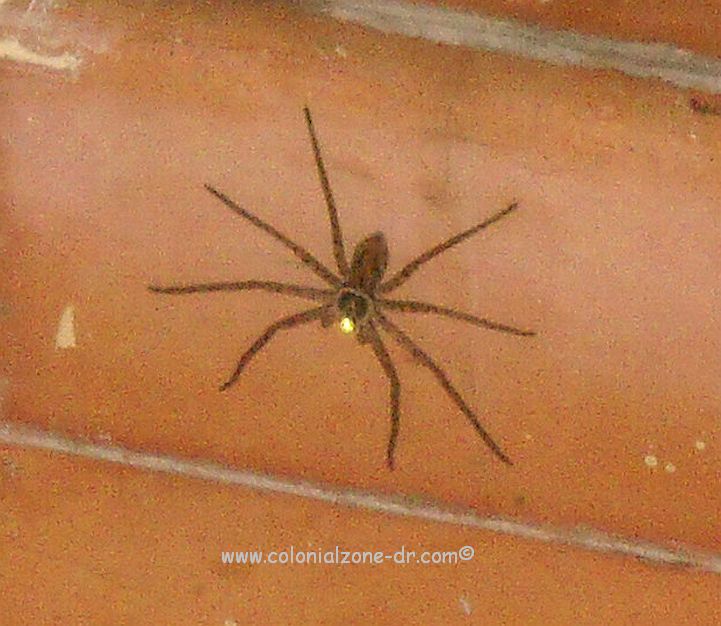
Heteropoda venatoria, the common name is Huntsman Spider. Also known as the Giant Crab Spider, Housekeeping Spider and Banana Spider.
This is a very common spider found in tropical and sub tropical areas throughout the world. Its leg span can reach 5 inches. I love the mask it is wearing that gives it a very fierce look. They can move very fast which also makes them a bit frightening but they are pretty much harmless, usually running away when a human approaches. They normally eat all types of insects, especially cockroaches, crickets and moths. For this reason many people do not mind this spider setting up home in their barns and sheds. They hunt on the go, usually at night, and do not spin webs attacking their prey before they even realize what happened. They can fit into tiny places because of their flat bodies.
If this spider does bite it is a little painful but not deadly or dangerous and many reports say that when they are disturbed they play dead. Some say it is bad luck to kill this spider as it helps us humans by eating all those nasty insects.
Thank you Tony for the information. There are some great spider pictures and information on the Dominican Spiders Blog.
+click image to enlarge...PLEASE (Seeing the larger image is incredible.) A Huntsman Spider in my room in Dominican Republic. The glowing thing in its mouth is a firefly. The one pictured is a female, a Huntswoman. It let me take a few pictures then ran off into the cabinet.
Noseeums (No-see-ums) in Dominican Spanish: Mayes (may-gee's) (found near the sea) and Gegenes (found in the hills). No matter what you call them these nasty little creatures are true blood suckers. They are known as Punkies, Midges, Black Gnats, and Black Sand flies. (In Spanish: Moscas de Arena, Chaquistíes, Zancudos Negros). These loathsome flies come from the family Ceratopogonidae. They are teeny, tiny, biting, persistent little buggers that are, in my opinion, worse than mosquitoes. Less than ¼ inch long and can get through a normal window screen with no problem. No problem for them but big problems for their unawares meal that just may have your name on it!
Since the noseeum cannot be seen (maybe this is why they have this nickname??) and the immediate bite can't be felt, they can make your blood a feast before you really know what's happening. Walking along ever so innocently one can easily stir up a swarm without knowing. If you're lucky they will swarm. In a swarm they can be seen, a

Picture of a nosseum. (Sorry, what did you expect with a name like noseeums)
dark foreboding mass. The only problem with this swarm is they can enter any open body cavity (i.e. the mouth and nose). If you happen to find yourself in a swarm I strongly suggest that you close these openings. That is, unless you want to be choking on their little, bitter tasting carcasses (yes, I know the taste well). If you have been swarmed move along quickly and get out of their territory, as they don't like to travel very far from their home. So, I say, when you see a black cloud of flying bugs coming toward you..RUN AWAY! RUN AWAY!
These blood sucking mini vampires usually live in shrubs and ground cover. Along the water, marshlands, beaches and areas where it is damp. But they can be found just about anyplace. Even in the soil around your home or in your favorite potted plant. They are unlike mosquitoes as they do not need water to produce their offspring. Moisture will do just fine for them and their offspring.
The female, the only gender of these vicious little buggers that sucks blood, will get you before you know what is happening. She needs the protein in your blood for her to be able to pro-create and be mommy to the next generation of these relentless creatures. She will find you by smell. As with any persistent woman out for blood, it is not easy to hide. This unrelenting female will suck the blood of anything that has this red substance flowing through their veins.
After taking the blood, of course they need to leave you a little gift so you remember them. Left behind is a little red blotch that is extremely itchy that shows itself a few hours after the attack. The skin is usually raised and there in a small center red dot where they stuck you. Try not to scratch these red spots as they will just get itchier and could get infected.
The red spots can plague you for a few hours up to a week or more. Usually there are many blotches and you can look like you have some sort of disease before they turn from bright red to a light fading pink. Rest assured the blotches will disappear in time. All that will be left behind is the memory of what these minuscule, almost invisible vampire-ettes can do to reek havoc on your nerves and flesh. You will for sure remember to watch out for them in the future, even if you can't see them.
Be sure to use some type of insect repellant. Something with DEET is best. It is said that if you do not want to put those chemicals on your body that you can use Catnip, lavender, cedar, or even patchouli oils. Don't wear light colored clothing as this attracts bugs. They say (do you know who they are?) that eating too many bananas can attract biting bugs. If you eat garlic or eat lots of hot peppers (bugs and humans alike won't come near), take vitamin B or brewers yeast, this is supposed to help also. To ease the itch rub parsley, lemon balm, or the inside of a banana peel on the spot. (*NOTE-these are all things I have read and some I have tried myself. Use what is best for you. These natural remedies are not tested and may not work for you. I just like learning of the natural ways to rid myself of bugs and their after effects. This is probably why I always have bites on my body)
Interesting note - these tiny insects are found in abundance in amber. Seemingly attracted to the color of the fluid. The DMS extracted from these pesky creatures has been very helpful.
More detailed information: http://www.ext.colostate.edu/pubs/insect/05582.html
The Hispaniolan Woodpecker/ Pájaro Carpintero de la Hispaniola (Melanerpes striatus)
The Hispaniola Woodpecker is a medium sized woodpecker is only found on the Caribbean island of Hispaniola in the countries of Dominican Republic and Haiti. They can be found throughout the entire island.
This noisy woodpecker travels in groups and is very social unlike most woodpeckers. They also watch out for other colonies members nesting young.
They are easily spotted because of their pointy beaks, their yellow and black striped body feathers, their greenish grey rump and the distinctive red head. Of course, these birds have the noticeable red on their heads. The males red striped goes from the forehead to their heck and the female species red markings are much smaller and can only be seen extending from the nape to its neck.
Here in Dominican Republic many parts of the country do not like these boisterous birds. One of their favorite nesting places is in cacao (cocoa) trees damaging the tree and they also like to poke through the seed pod making it easy access for insects and other organisms that can damage the crop. According to (http://www.tandfonline.com/doi/abs/10.1080/09670878509370969#preview) pod damage was assessed at 3.7% in 1981 and 3.5% in 1982, close to the 4% estimate by the Ministry of Agriculture of the Dominican Republic. The Ministry established a bounty program on the Hispaniola Woodpecker in 1976, our study suggested this bounty should be discontinued. The program was found to be not cost effective, and did not reduce damage, and had an adverse effect on other avifauna.
+click the pictures to enlarge
Top - A Hispaniolan Woodpecker visiting an old building in the Colonial Zone, Dominican Republic.
Middle - The woodpecker lightened so you can see the colors better
Bottom - The Woodpecker and Pigeon hanging out on the roof of the Convento y Iglesia de Santa Clara in the Zona Colonial.


Continue learning about the Creatures of Dominican Republic Page 3
[TOP]
[TOP]
Hispaniolan Hutia/ Capromyidae | Agouta or Juron/ Hispaniolan solendon | Cacata/ Tarantula | Manatee | Heteropoda venatoria/ Huntsman Spider | Noseeums (biting insects) | The Hispaniolan Woodpecker/ Pájaro Carpintero de la Hispaniola | Hispaniola Boa/ Boa de la Hispaniola | Jaragua Sphaero | Assorted Pictures | The Village Weaver / Madame Sagá | Black Witch Moth | Under The Dominican Sea |

