

If you found my web site useful consider making a donation through Pay Pal.
Thanks!

|
|

Custom Search
Gracias a coinmill.com


How Dominican Republic Celebrates Carnival
Home | Dining & Night Life | Hotel | Sights | Pictures | Music | Colonial Zone Map | Hot Spots! Directory | Site Search
site map Copyright © 2005 - 2016 All Rights Reserved. Colonial Zone-Dominican Republic (DR)
Our complete exchange rate tool.
Home | Calendar | Night Life/Dining | Sight Seeing | Pictures | Businesses | Artists | Food | Helps | History | Language | Music | Media | Pastimes | Products | Tradition/Legend | Links | About Us | Buy Mamajuana | News Blog | DR Gringa's Life Blog | Dominican Dog Blog | Web Designer
[TOP]
Culture, Traditions and More
Traditions | Myths and Legends | Superstitions | Religious Beliefs | Celebrations of Patron Saints |

Dominican Republic Carnival / Carnaval Dominicano - History and Origins of Carnival Dominican Republic
Carnival - Early History | Video - Slaves Abused By Spanish Captors | Celebrations Worldwide | Video - Children Dancing | Carnival - Dominican Tradition | Video-The Dancing Girls, Fire Throwers | La Vega | Locations | Roba la Gallina Video | Carnival Characters Page 1 | Carnival Characters Page 2 | Links to other Carnival web sites | Complete list of our Videos of Carnival | Links to all the Picture Albums | Carnaval in Cuidad Colonial 2013 Picture Album | Carnival 2012 Picture Album | Carnivals past Slideshow | Carnival 2010 Slideshow | Carnival Slideshow 2008
Carnival Celebrations Activities 2016 on the Colonial Zone News Blog
Carnival is a countrywide festival, with each town having their own version of the custom. Every town adds a touch of their own flair to the merrymaking with diverse masks, costumes, characters, music and methods of celebrating. Even though there are many differences the thing all the celebrations have in common is they are all charged with unbridled energy. Carnival is also very family orientated, having both young and old join in the festivities. Participating groups can consist of family units, clubs, friends, families and businesses, all can participate in the carnival parade of masked and painted creatures.

Carnival Dominican style is a colorful and vibrant part of the culture here on the island of Hispaniola in the country of Dominican Republic.
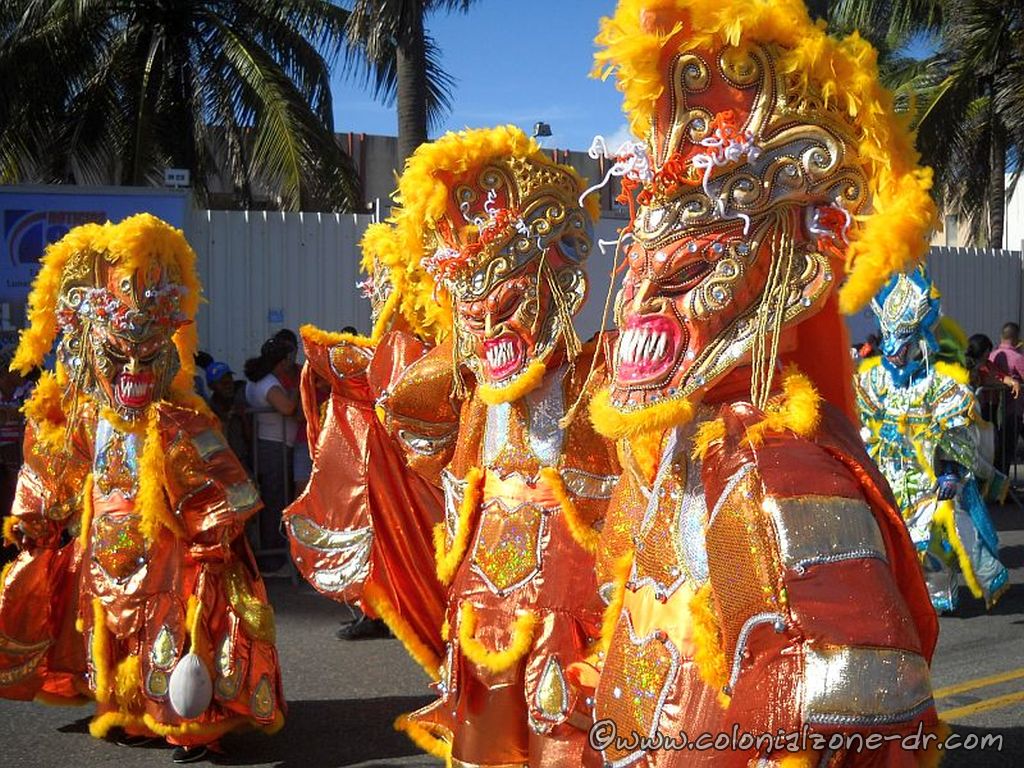
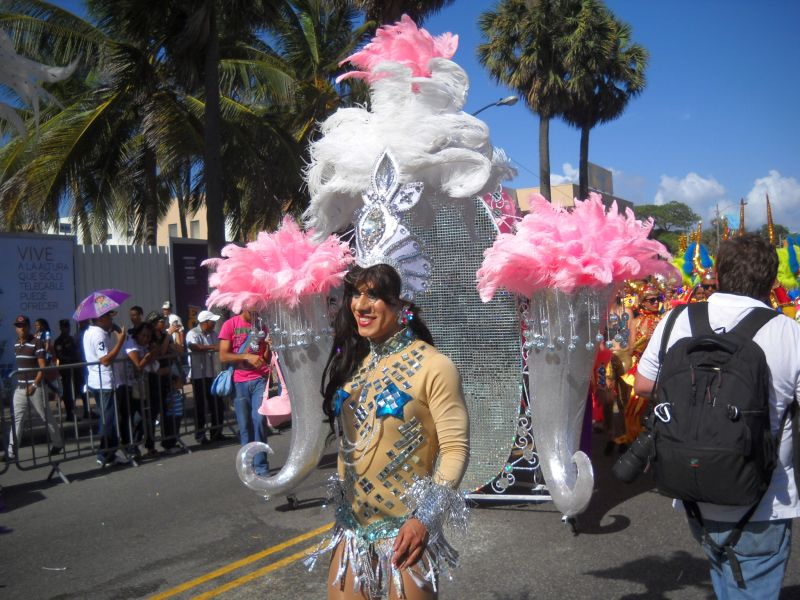
Of the many costumes and creatures represented the most celebrated seem to be the devils known as Diablos Cojuelos. Others are painted bodies, or bodies decorated with paper. And yet others may have animal masks or elaborate costumes. Many disguises and get-ups symbolize the opposite, a world upside down. This is where the humor enters the scene. Men may dress as women. All is the opposite of what one would expect. This can be very funny to observe. Some costumes represent the Indians or mock the dress of the conquerors and oppressors of the island, the Europeans. These costumes are a mix or all the cultures, beliefs, peoples and ideas, making for a unique viewing experience. The costumes are only limited by the imagination of the creator.
+click to enlarge
The diablos cojuelos with their frightening and evil looking masks
+click to enlarge
Young and old join in the celebrations
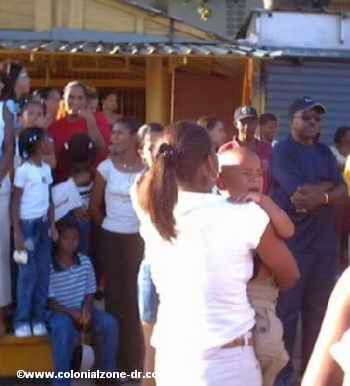
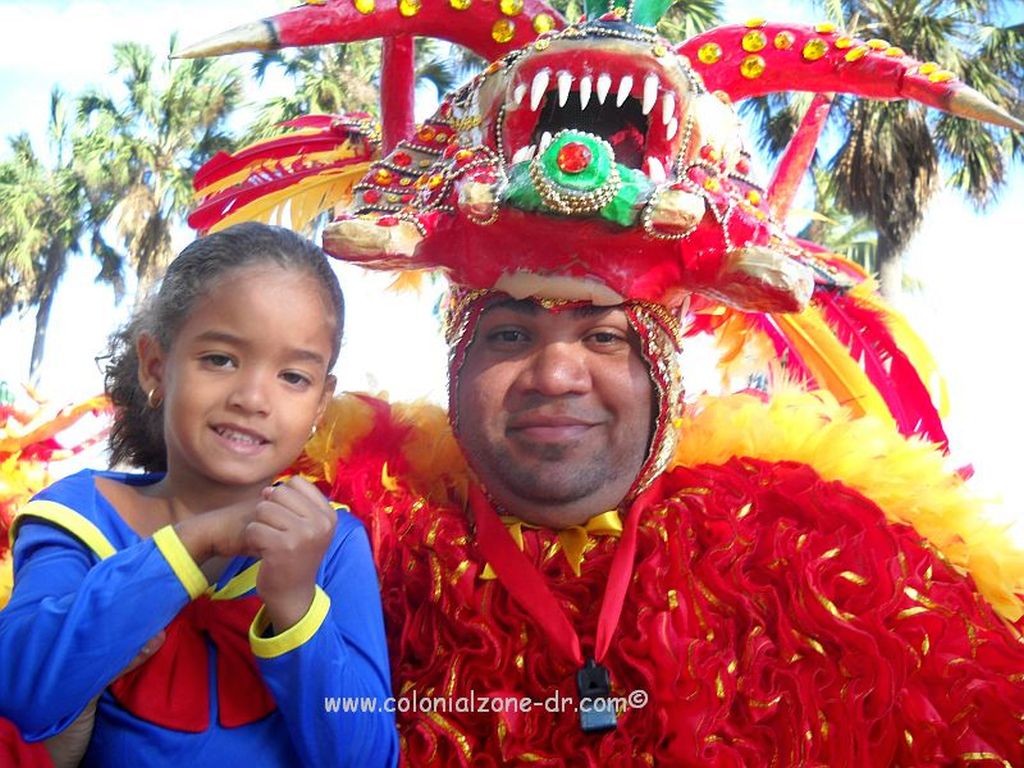
It is enjoyable watching the children delighting in the carnival activities. Some are afraid and hide behind their parents. The parents love getting thier little ones pictures taken with the masked creatures. Many children like to get dressed up in masks or paint their faces. They will mask themselves in whatever they have available. It is fun to see just how creative the children can be when need dictates. The future generation of carnival parades are being spawned. (to see many more pictures of Carnival)
+click to enlarge
A frightened child being held by mom during Carnival activities
+click to enlarge
A happy little girl being held by a smiling Carnival Diablo
The Carnival is very good for the economy bring in tourists by the droves. All are coming to observe this spectacle. It helps the entrepreneurs with their home businesses creating masks and souvenirs that are all carnival orientated. The mask makers, the trinket manufacturers, the food vendors, the transportation industry. All have a chance to make a nice profit during the month of February thanks to the carnival. Mask makers can start creating as soon as carnival is over, preparing and designing for the following year. Readying a town for carnival usually starts immediately after the Christmas celebrations. Getting all ready to make money for the town and its people and to have a good time.

+click to enlarge
Men dress as women
Carnival can be a very competitive pageant as there are prizes given for the best of the best in many different categories. With artist and participant working together to get the right fit and the look they desire. They can work all year making their costumes so they can join to celebrate and compete in this festival. Costume design and character presentations come together for the judging of the best groups in Carnival. The capital celebrations only permit up to 150 groups participating per region. Here the winners of the local Carnival events merge for this the grandest of competitions. Original masks, costumes, floats and masked dance groups fuse to create a flood of activities in the streets. There can be than 50,000 parade participants joining in the Malecon parade in Santo Domingo with over half a million people that bombard the capital to watch and join in the carnival celebrations. All this is presided over by the King of the Carnival who is elected every year.
Carnaval Dominican Republic 2010 on the Malecon, Santo Domingo. The Dancing Girls, Fire Throwers, Soy Dominicano and more. The flavors of Carnival Dominican style. To watch on YouTube https://youtu.be/nnol2k9EtzU
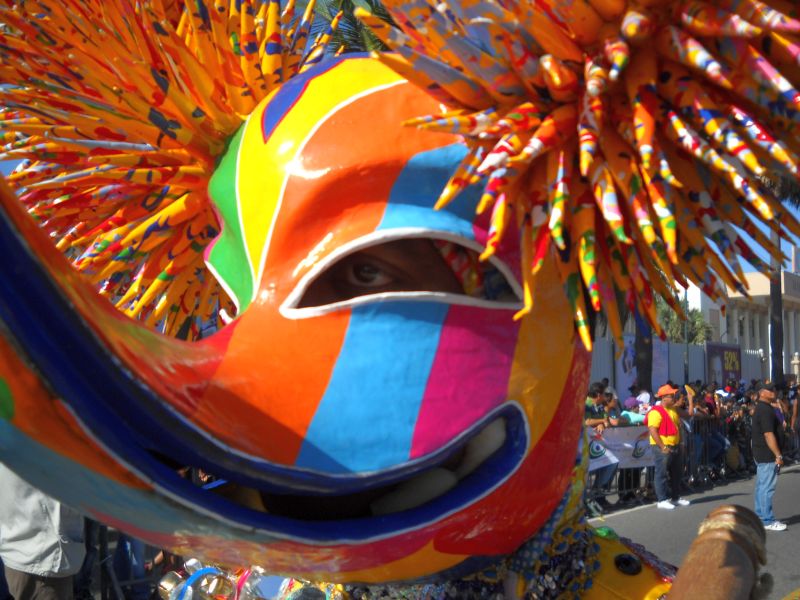
Each troupe will represent different regions and towns throughout Dominican Republic. A town or bario will have his or her own unique costumes and customs. For many, each year the costumes must be different. Some burn their costumes after the carnival, which represents change or closure, while others give their used costumes to the children. These costumes are widely diverse, some made of bright materials including satin and taffeta. Some are decorated with small round and square mirrors, bells, ribbons, whistles, tiny dolls. While other costumes are fierce, repulsive and quite hideous. Many can be very beautiful and elegant. Some of the troupes portray past historical events and tragedies. There are men dressed as ladies, bodies covered in black grease, and other bodies brightly painted. (A list of the Carnival Troupes web sites)
+click to enlarge
Representing the tragedy at Rio Blanco in Jimini when many people died buried under a hugh mud slide
+click to enlarge
Close-up of a mask where you can see human eyes inside
[TOP]