

If you found my web site useful consider making a donation through Pay Pal.
Thanks!

|
|

Custom Search
Gracias a coinmill.com



Carnival Dominicano Masks and Descriptions Page 1
Home | Dining & Night Life | Hotel | Sights | Pictures | Music | Colonial Zone Map | Hot Spots! Directory | Site Search
site map Copyright © 2005 - 2016 All Rights Reserved. Colonial Zone-Dominican Republic (DR)
Our complete exchange rate tool.
Home | Calendar | Night Life/Dining | Sight Seeing | Pictures | Businesses | Artists | Food | Helps | History | Language | Music | Media | Pastimes | Products | Tradition/Legend | Links | About Us | Buy Mamajuana | News Blog | DR Gringa's Life Blog | Dominican Dog Blog | Web Designer
[TOP]
Culture, Traditions and More
Traditions | Myths and Legends | Superstitions | Religious Beliefs | Celebrations of Patron Saints |

Dominican Republic Carnival / Carnaval Dominicano - History and Origins of Carnival Dominican Republic
Carnival - Early History | Video - Slaves Abused By Spanish Captors | Celebrations Worldwide | Video - Children Dancing | Carnival - Dominican Tradition | Video-The Dancing Girls, Fire Throwers | La Vega | Locations | Roba la Gallina Video | Carnival Characters Page 1 | Carnival Characters Page 2 | Links to other Carnival web sites | Complete list of our Videos of Carnival | Links to all the Picture Albums | Carnaval in Cuidad Colonial 2013 Picture Album | Carnival 2012 Picture Album | Carnivals past Slideshow | Carnival 2010 Slideshow | Carnival Slideshow 2008
Carnival Celebrations Activities 2016 on the Colonial Zone News Blog
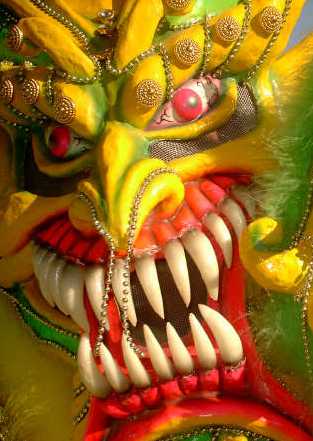
There are many different names used as well as the ways in which the Carnival participants present themselves here in República Dominicana. The costumes are each different and represent the communities and regions from which they come. These elaborate masks, mainly the Diablos, are made in secret in little out of the way, hidden places where one would never imagine that there was a work of art being created there. These costumes are highly guarded, as they want all to be a surprise and not want their secret out until Carnaval time has arrived. Also, there is much money and notoriety to be won by having the best costumes.
Some of the masks are homemade by the wearers and the group participants. The more elaborate costumes are professionally made using real teeth, horns and skins mainly of cows. Traditionally they make a mold of clay and cover it with a yucca starch paste like papier-mâché (paper mache). The masks are shined, painted and decorated. The inside is lined with foam fashioned to fit the wearers face. Recently the mask making process has changed a little. Many of the masks now are being made with plastic replacing the paper. When the mold is ready they are using fiberglass, rubber and silicone. This makes the making of the mask faster and they are more resistant to sweat and weather.
I have some of the names of the masks and troupes I have located. There is so much variety and character descriptions I hope I got the information correct. Different people I ask and different sources I have read all have a little different information. At least you will get the general idea of how diverse, original and creative all these costumes and their creators really are.
+click to enlarge
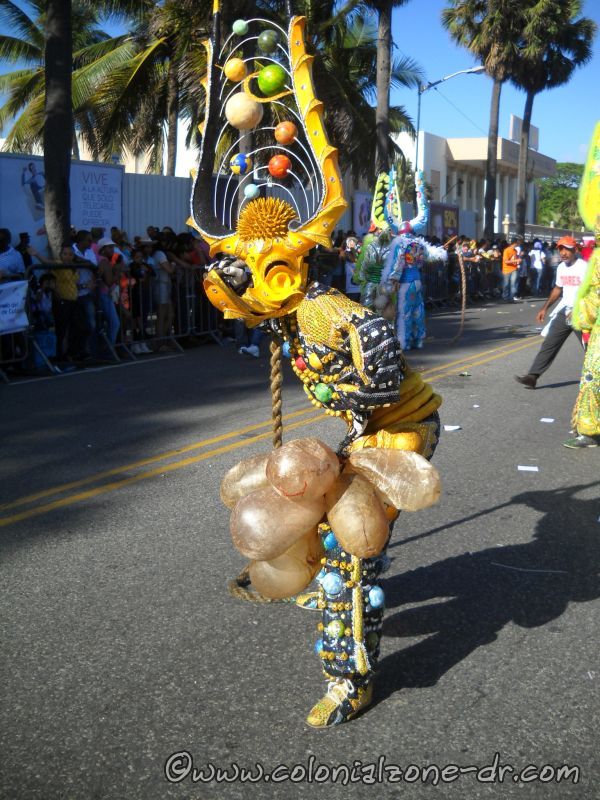
A Diablo mask that is very intricate made for the Dominican Carnival
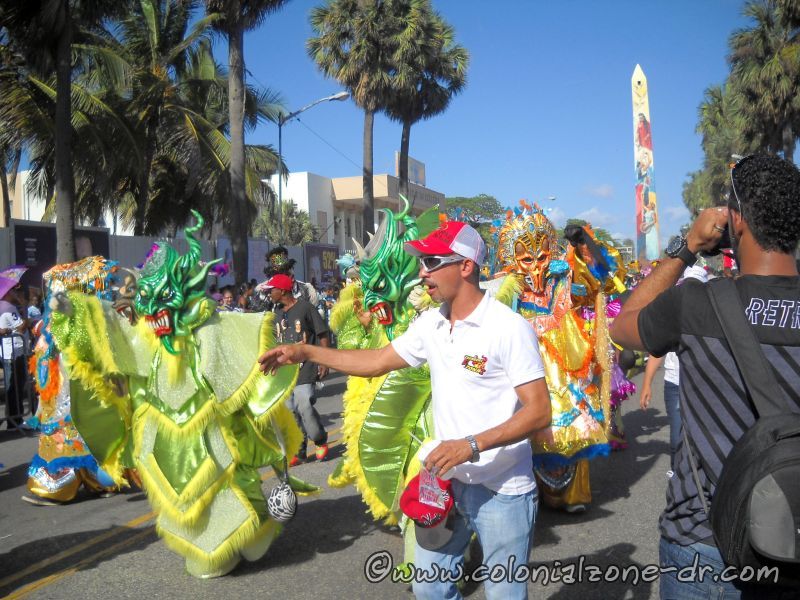
Some of the most famous of all these masked demons are the Diablo Cojuelos/ Devil who walks with a limp.(from La Vega) This devil, as the story is told, was a demon banished to Earth because of his clownish pranks. When he fell to earth he hurt his leg and from now on always walks with a limp. These evil looking creatures are multi-horned, sharp toothed beings. They always have very elaborate masks.
Many of the regions have varying versions of this horrific devil. Some wear the mask atop their heads making it almost seem as if they have two faces. They all wear costumes that are brightly decorated with variations on the embellishments and mask styles. Some costumes are covered with bells, dolls or stuffed animals. These costumes are layered with ruffles or all types of fancy vibrant decorations. Some have ruffles that cover the entire back of their heads. Their walk, supposedly limping, really looks to me like frenzied dancing and jumping. How they get all that energy wearing those hot costumes is beyond me.
+click to enlarge
Diablo Cojuelos take over the Malecon during Dominican Carnival
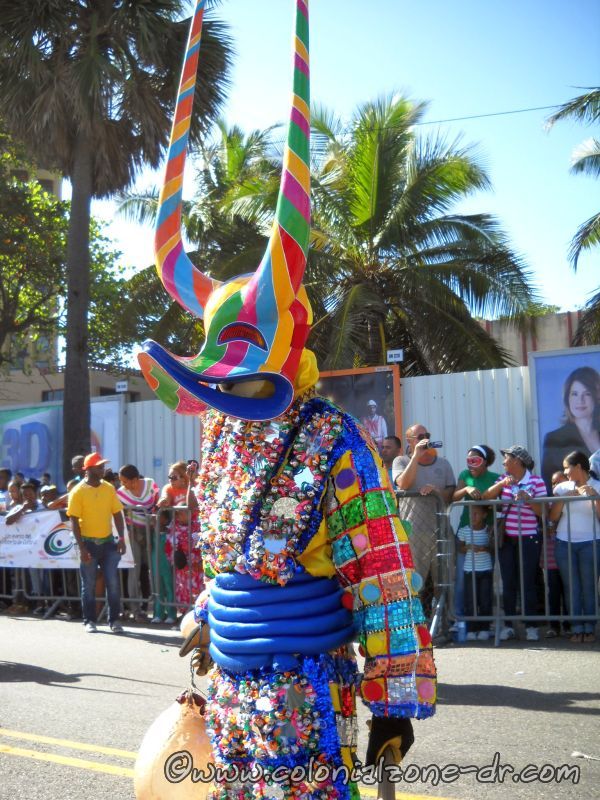
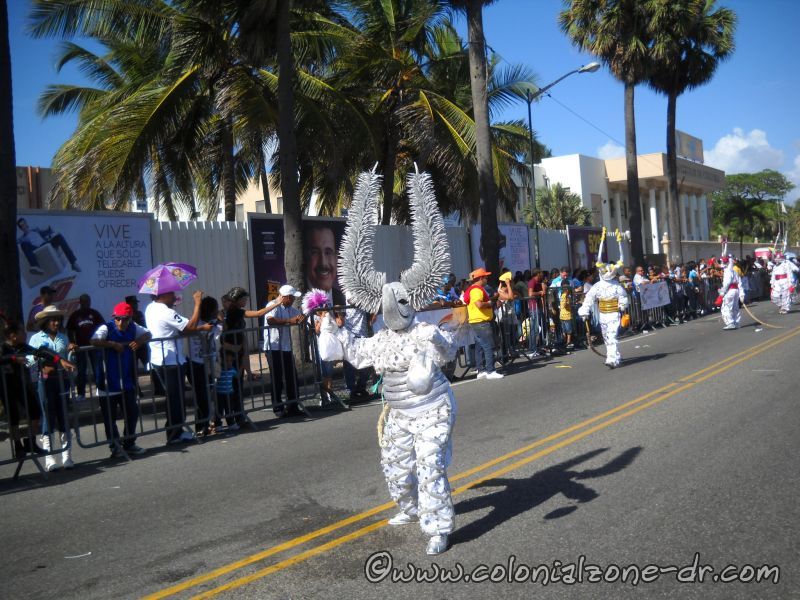
Lechones/ Pork Eaters (from Santiago) are traditional Carnival characters. They have elaborate galactic designed satin and taffeta costumes decorated with mirrors, beads and bells. They wear papier maché masks with a duck-like bill, big horns and carry a whip. Some of the masks resemble pigs.
+click the images to enlarge - Left and right are different costumes of the whip cracking Lechones
Watch the video of Los Lechone on You Tube
Nicolás Den Den (from Santiago) is a fat, dirty, dancing bear chained to his human master. His comedic antics make the children laugh. The same costumed characters in Montecristi is called el Oso Nicolás.
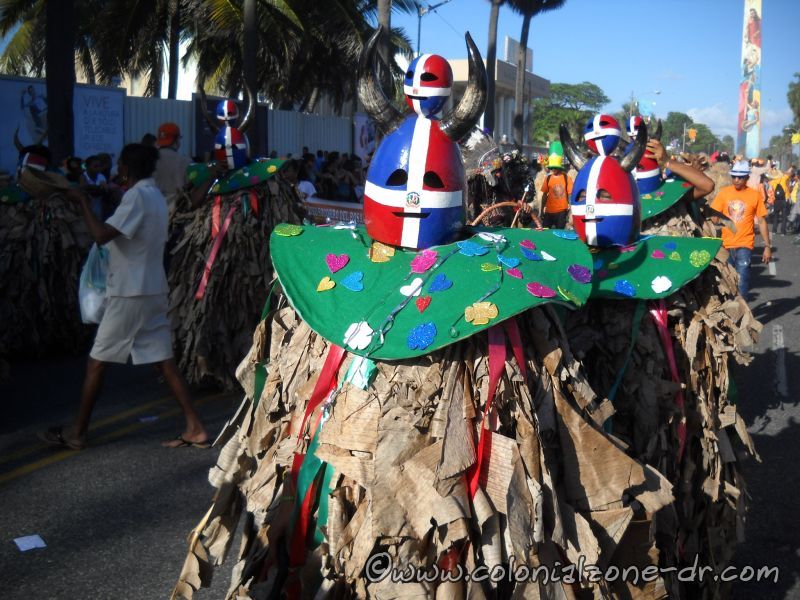
Los Platanuses (from Cibao) are covered in plantain leaves, wear painted gourd masks and carry the whip.
Trapuses/ Rag (from Bonao) wear long colorful rag strips that are woven together and have a mask of the same material or just paint their faces.
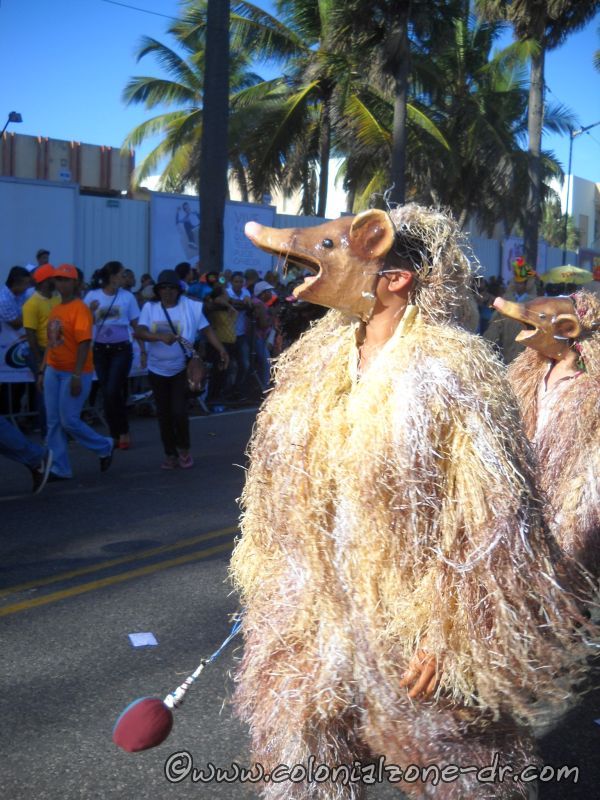
Papelus/ Paper (from Cibao) and El Papelón/ Newspaper print (from Salcedo) wear costumes made of shredded paper (newspapers, colored crepe paper, shopping bags) or colored plastic bags with gourd masks and carry vejigas/ the inflated bladder weapons or látigos/ whips
Se me Muere Rebeca (Salcedo) - Represents a desperate mother who wants to keep her daughter who was seriously ill happy. Walking and screaming she stops and asks for treats for her ill daughter who is represented by the doll she carries. She is usually followed by groups of children.
Los Alí Babá. These costumes and dance represent Eastern presence with an Arabian flair. Watch the Los Alibaba Drumming video on You Tube
Los monos de Simonico/ The Monkeys (from Villa Duarte)
Máscaras del diablo (from Elías Piña) - These devil masks are adorned with red ribbon. These mask wearers traditionally do not speak. It is said if you find the identity of the person wearing the mask you will drop dead on the spot.
Macarao/ Big Mask (from Hermanas Mirabal/ Salcedo and Bonao) wear big devil masks that have large mean teeth representing different kinds of animals. Their clothing is made of crepe paper streamers.
Pepines (from Santiago) wear masks with horns with short points covering them
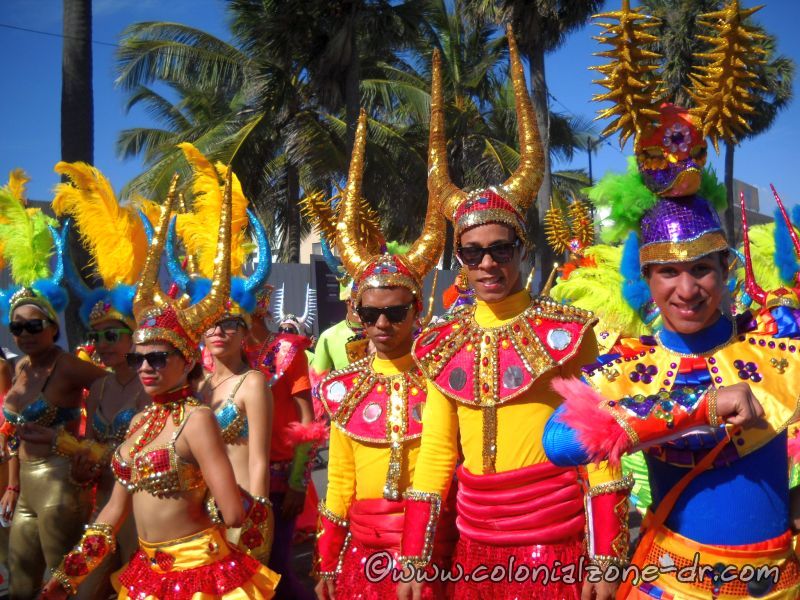
+click images to enlarge
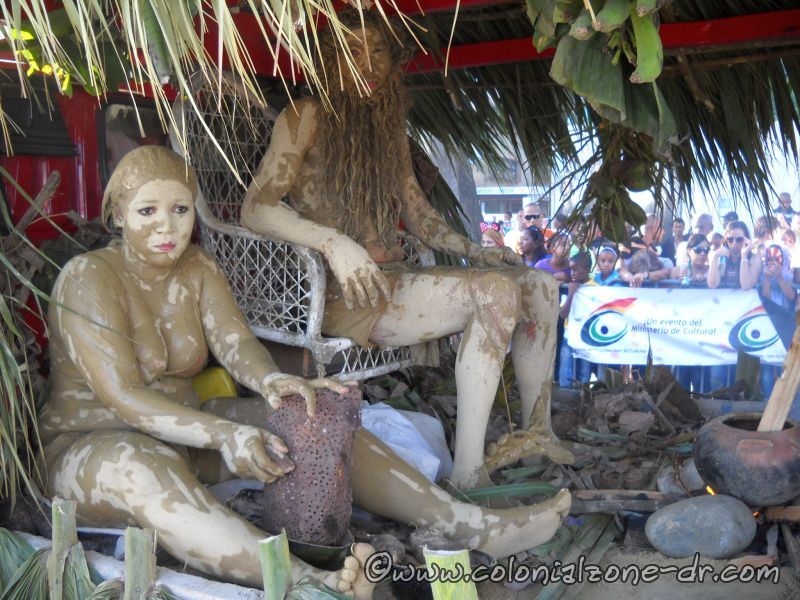
Mudmen amd Ladies portraying everyday life of the indigenous people
+click images to enlarge
Shredded paper Papelus
Mudmen are a group of underwear wearing men and women that are encrusted with colored mud.
El Mediodía/ The Mid Day is a man dressed as a woman with the colors of the flag painted on their face.
General Cocotico wears a palm leaf stem to represent armor
+click image to enlarge - Los Platanuses with a Dominican Flag gourd mask
+click images to enlarge
Los Ali Baba in their bright costumes
+click images to enlarge
Pepines with their pointy masks

[TOP]