La Capilla del Rosario/ The Chapel of the Rosary
Located across the Ozama river (easily seen from the Plaza de España) is one of the first chapels of the New World.
The full name of this marvelous cathedral is the Cathedral Metropolitana Santa María de la Encarnación. Originally when this church was built in 1514 it was a hut made of royal palms. It now takes up an entire block.
Diego Columbus set the first stone and since then many additions and changes have been made to the original structure. Spanish workmen began building the cathedral but left to search for gold in Mexico. This second church was much better, it was made of wood and the roof was palm branches. If there was rain there was no service. At the end of 1537 the roof was rebuilt the way we see it today. The front is dated 1540 and was completed in 1544. In 1547 the construction of the tower was stopped because it brought attention to the Fortress from marauders and people wanting to attack.
The church was worked on and designed by so many different people. This is why so many architectural styles can be seen in one building. There are Roman style arches and Gothic style vaults with some Baroque ornaments thrown in for good measure. All this only adds to the buildings originality and powerfully dominating look. It is built with the coralline blocks, as with many of the Colonial era structures, this building has been able to withstand the ravishings of time and humans both.
Cathedral de Santa Maria | Capilla del Rosario/ Chapel of the Rosary | Iglesia y Convento de las Mercedes/ Church and Convent of Our Lady of Mercy | Iglesia Nuestra Señora de la Altagracia | Convento y Iglesia de Santa Clara/ Convent and Church of Santa Clara | Chapel of San Andrés | Iglesia del Carmen/ Church of Our Lady of Carmen | Iglesia de San Miguel | Ermita de San Antón/ Hermatige of San Anton
This small chapel was constructed on the original land where Bartholomew Columbus founded the Villa of Santo Domingo in 1498. This location was where the first colony was established. This chapel, built in 1544, was constructed of wood and beams gathered from the ships and straw. It was dedicated to La Virgen de la Gente de Mar/ The Virgin of Seafarers (Sailors). In 1544 Father Fray Bartolome de Las Casas heard Mass there when stopped in Santo Domingo, during his trip to Chiapas, where he had been appointed bishop.
The original settlement on this side of the river was abandoned when the water quality was found to be better on the other side of the Rio Ozama. They moved across the river to the city that is now Santo Domingo that Governor Frey Nicolas de Ovando founded.
This church is the works of Rodrigo de Liendo. Construction began in 1549 and finished in 1555. It was known as one of the most distinguished temples in the Indies. This is one of the most loved temples by the Dominican people. They come here to pray to the Virgen de las Mercedes.
Originally built as a gothic type temple, with a baroque altar and lateral ornamentations of silver. It also included several smaller chapels. The church underwent several changes and remodeling. In 1635 two gothic arcs were added to enhance the dome ceiling. A bell tower was also added to the structure. In 1910 the back part of the church was changed into a convent. The building could not stand up to the earthquakes so the walls were strengthened which, in turn, made the building lose much of its original gothic splendor.
Directions: From Calle el Conde turn north onto Jose Reyes. Walk 2 blocks and turn left onto Calle Mercedes. See the map (number 9)
Originally built by Nicolas de Ovando in 1503. It was a small stone chapel.
Rebuilt in the 1920's over the original building in an Elizabethan Gothic style. The wall of this church was once shared with the Hospital San Nicolás de Bari, the ruins that run along side this church. Within these walls is the remains of the original 1540’ brick Capilla de la Concepción / Conception Chapel. Inside the large church the decoration is strongly influenced by Arab and Spanish art. Some of the art includes the Sol de Oro / Sun of Gold, a model of the star that announced Christ's birth, and a beautiful altar.
The Virgin of Altagracia is the protector saint of the Dominican Republic, celebrated yearly on January 21. More information on Alragracia.



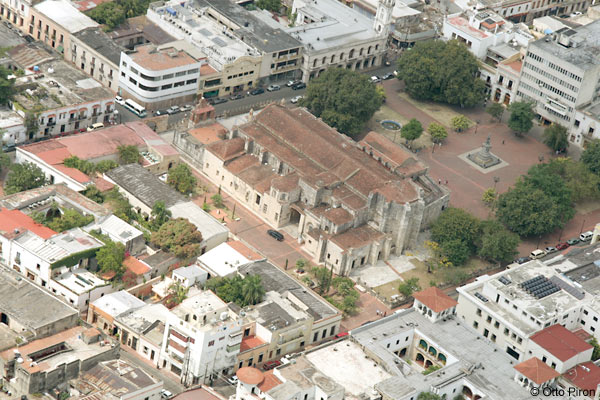
Cathedral de Santa Maria/ The Cathedral of Santa Maria - Cathedral of Santo Domingo, The First in America / Catedral de Santo Domingo, Primada de América
The first church/ cathedral in the Americas.
+click image to enlarge
Aerial view of the Cathedral de Santa Maria and Colon Park.
more pictures of the Cathedral (opens in new window)
The building historically has been used as a slaughterhouse and a prison. It was a wine and provision storage facility used by the pirates when it was ransacked in 1586 by Sir Francis Drake.
When you enter the cathedral you will feel a calmness come over you. Seeing the interior for the first time is a real experience. It is so quiet, relaxing, and overpowering and yet it has such a reverent feeling. Make sure to look up toward the heavens and notice the vaulted ceiling made to look like palm branches representing the original roof of the first church. There are many different chapels inside the large structure. The stained glass is magnificent. The mahogany alter, the carved animals, the statues, the high hammered silver alter, it is all so beautiful. It holds the mausoleums of some archbishops including Geraldini Bastidas. It holds the tombstones of Simón Bolívar. There is a touch stone on the wall where people of the Colonial City would come to the cathedral for refuge. They would touch the stone when entering and be safe from attackers. There is a painting dates from 1523 of La Virgen de la Altagracia. It is even said that Columbus remains were kept there until they were moved to the Faro a Colón.
Cost: Free. Mon.-Sat. 9-4; Sun. Masses begin at 6 AM Proper dress required.
Location: The east end of Calle el Conde at Arzobispo Meriño, Colonial Zone at Parque Colon
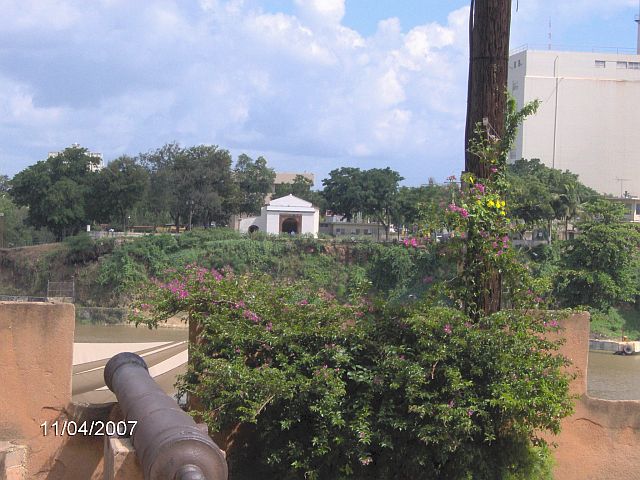
+click image to enlarge
Chapel of the Rosary across Rio Ozama
pictures of the Chapel (opens in new window)
This building was used as a military compound during the Haitian occupation. It was also used for smuggling during the 17th and 18th centuries.
Some of the original Taino Indians that adapted to the Spanish way of life lived in this area.
Much research has been done at this location and it is found that the lime stone floors are dated from the 15th century. Found were Spanish potteries and a container for holy oils. Also there were many skeletons found dated from many different eras.
Santa Ana. Later it was changed and named after Santa Clara and the nuns/ monjas Clarisas. In 1873, the monastery in ruins, was given to the Sisters of Charity of Cardinal Sancha/ las hermanas de la Caridad del Cardenal Sancha, who restored it and now occupy a college where they operate.
The monastery was created for girls in the city Ozama (Urbe del Ozama) to study and be educated. The founders were Franciscan who wore the brown sackcloth robe tied with a cord and a brown cape. These Franciscan monks are still seen walking through the Colonial city. The sisters now live behind the church on Calle las Damas. The iglesia houses a school where some days you can hear the children gathering in the church singing hymns with the sound coming out into the street like a soft wave.
The building is very plain consisting of a smooth, non-descript outer wall and a very simple entryway. The interior is decorated in Gothic style.
Location: From east Calle el Conde turn south on Isabel la Católica about 2 blocks to Padre Billini, Zona Colonial
The Chapel of San Andrés
This was the second hospital to be built in the colonial city of Santo Domingo.
The use of brick as its major building material made this chapel a marvel. Built next to the Hospital is Chapel Padre Billini, both seem to blend together to almost form one structure. The wooden sculpture inside the chapel is very unique. Here, it is told, is the place where the people of Santo Domingo conspired and planned their revolt over the Haitian occupation in 1844.
Location: From Calle el Conde turn south on Sanchez. Go 1 block to Calle Arzobispo Nouel. see the map (number 70)
Iglesia Nuestra Señora del Carmen/ The Church of Our Lady of Carmen
The Brotherhood of Remedies and of Carmen, a small group of parishioners, wanted to have a small chapel for their meetings. They built their small chapel in 1615 on a plot of land owned by the San Andres Hospital.
In 1729 the chapel was enlarged. The main entrance door dates back to this period. It was christened the Plazoleta de la Trinitaria and was used as a meeting ground for the Dominicans who led the revolt against the Haitians who occupied the city in 1844.
Iglesia de San Miguel
The first mention of this church was in 1650. It was first constructed entirely of straw and later changed to stone. It was almost entirely destroyed in the big earthquake as with many of the buildings in Colonial Zone. In 1765 it was used as a parish during the construction boom of this era. It is a simple construction, a not so good attempt at Baroque style. The image of Arcángel San Miguel, the Angel who defends the people against Satan, is impressive.
Location: From Calle el Conde turn north onto José Reyes. Walk about 4 blocks to Juan Isidro Pérez near Calle Restauracion. see the map (number 11)
This building was one of the originals built by order of Nicolas Ovando in 1502 with it's original name being San Antonio Abad. The building was set afire by Sir Francis Drake and then almost completely destroyed by the hurricane San Zenón in 1930.
The small chapel has been rebuilt totally and painstakingly after many years of abuse and thievery. Thanks to old pictures they were able to make this the new version as close to the old as possible. The chapel now has no objects of religious significance inside. As of this writing (2012) it has not been kept up well.

Iglesia Nuestra Señora de la Altagracia / Chapel de Altagracia
A tribute of love, recognition and eternal memory.
During the procession on Altagracia Day on January 21st the virgin is carried throughout the streets of the Colonial city on glorious golden throne donated by then President and dictator Trujillo (the church organ was also donated by Trujillo)
Location: From Calle el Conce turn north on Hostos. Go about 1 block (long block) between Luperon and Las Mercedes, Colonial Zone, Santo Domingo See the map (number 14)
+click image to enlarge
Church of Altagracia
See the entire Church and Ruins slide show (opens in new window)


Home | Dining & Night Life | Hotel | Sights | Pictures | Music | Colonial Zone Map | Hot Spots! Directory | Site Search


MENU
IN COLONIAL ZONE
THINGS DOMINICAN
If you found my web site useful please consider making a donation through Pay Pal . Thanks!

Our complete exchange rate tool.
Gracias a coinmill.com

The nuns of Santa Clara arrived in the colony in 1552. The land where the Church and convent are built was donated by Alvaro de Castro, the public prosecutor of the Inquisition. Don Rodrigo Pimentel ordered that the convent was to be built in the 16th century, 1550 to 1559. Rodrigo de Bastidas, Diego Colón, Rodrigo de Pimentel y el Arzobispo Alonso de Fuenmayor all put in their ideas for the design.
This, the first convent of the new world, was occupied in 1590. When the French occupied the city in 1796 the nuns left for Cuba and returned in 1820. The church, convent and mausoleum of Christopher Columbus/ Cristóbal Colon and his decedents were originally dedicated to
Convento y Iglesia de Santa Clara/ Convent and Church of Santa Clara
+click to enlarge
Iglesia de Santa Clara
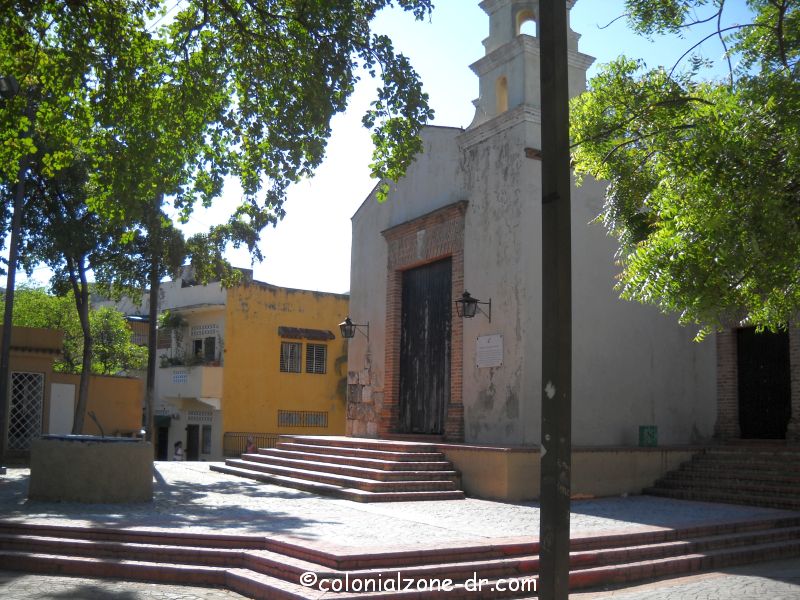
Ermita de San Antón/ Hermatige of San Anton
There is a small plaza that is near this chapel and many homes are built around and through where the old walls stood. It sits along the far northern walls of the fort San Francisco which connected the Monastery and the fort of the same name
Directions: From Calle el Conde go north on Merino about 4 long blocks. Pass the Ruins of the Monistary San Francisco to Restauracion and make a left (south) There is a plaza with many stairs. The little chapel is at the top of these stairs at Plaza de San Antón. Below calle Vicente Celestino Duarte see the map (number 20)
+click to enlarge
Ermita de San Antón
|
|

site map Copyright © 2005 - 2016 All Rights Reserved. Colonial Zone-Dominican Republic (DR)
Home | Calendar | Night Life/Dining | Sight Seeing | Pictures | Businesses | Artists | Food | Helps | History | Language | Music | Media | Pastimes | Products | Tradition/Legend | Links | About Us | Buy Mamajuana | News Blog | DR Gringa's Life Blog | Dominican Dog Blog

Custom Search

+click to enlarge
Interior church of San Miguel
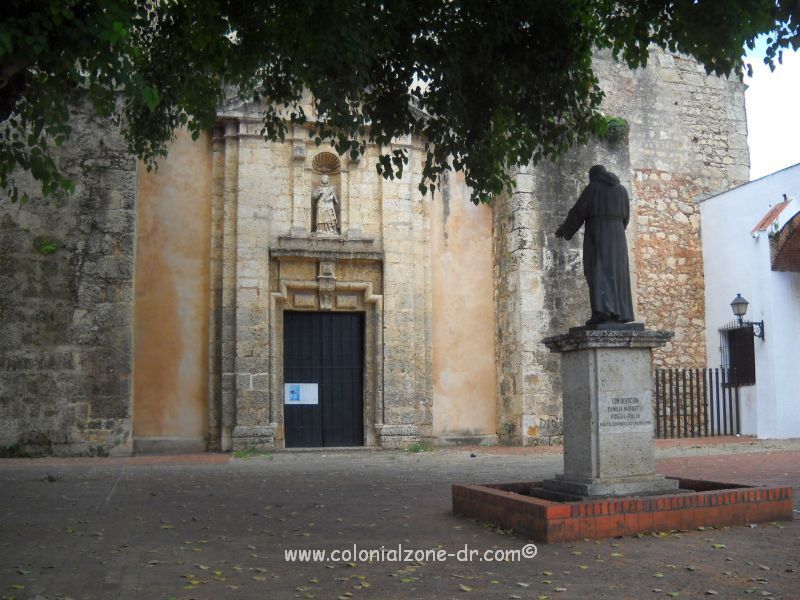
Iglesia y Convento de las Mercedes/ The Church and Convent of Our Lady of Mercy
+click image to enlarge
Iglesia y Convento de las Mercedes


Check out this Panoramic picture of the Cathedral and Parque Colon.

+click to enlarge
Inside this chapel there is a wooden sculpture of the Nazareno (Nazarene) who is a type of Christ.
Location: From Calle el Conde turn south on Sanchez. Go 1 block to Calle Arzobispo Nouel. It is on the left beside the Capilla de San Andrés. see the map (number 69)