

If you found my web site useful consider making a donation through Pay Pal.
Thanks!

|
|

Custom Search
Gracias a coinmill.com



Dominican Republic Transportation
Home | Dining & Night Life | Hotel | Sights | Pictures | Music | Colonial Zone Map | Hot Spots! Directory | Site Search
site map Copyright © 2005 - 2016 All Rights Reserved. Colonial Zone-Dominican Republic (DR)
Our complete exchange rate tool.
Home | Calendar | Night Life/Dining | Sight Seeing | Pictures | Businesses | Artists | Food | Helps | History | Language | Music | Media | Pastimes | Products | Tradition/Legend | Links | About Us | Buy Mamajuana | News Blog | DR Gringa's Life Blog | Dominican Dog Blog | Web Designer
[TOP]
To read about helpful transportation tips.
Important phone numbers to take with you when you travel.
To read a funny story about Dominican Drivers written by DR Gringa.
Getting around the island of Dominican Republic is not difficult once you understand the basics. It may seem confusing at first, trying to figure out the system. Once you understand the basics you will realize that the public transportation system in Dominican Republic is quite efficient and it is very affordable. With the many forms of public transportation including taxis, busses, motorcycles, public cars, guaguas, the new subway named Metro, horse and of course those good ole feet, here is always a way to get to where you want to go. Sit back and enjoy the ride!
Busses
*Oficina Metropolitana de Servicios de Autobuses/ Metropolitan Office of Bus Services better known as OMSA are the city buses and they cost between RD$10 and RD$15 (6/2014). Located in Santo Domingo and Santiago they ave many routes and stops. You can find more information in the "SERVICIOS" section at their web site.
The large busses that take you cross country are full size modern vehicles equipped with air conditioning. Most have on board movies and are quite comfortable as busses go. The average price from Santo Domingo to Puerta Plata by bus is about $6USD (2006-prices are an average). Remember to take a sweater on the bus. They can get very cold as they keep the air conditioning quite high. They buss is really a very comfortable way to travel any long distance.
*Caribe Tours Their location in Santo Domingo is Avenida 27 de Febrero and Leopoldo Navarro. They have routs throughout the country and take pride in their promptness. Make sure to take a jacket as sometimes their air conditioning is a bit strong. Check their web site for bus destinations and schedules. Phone in Santo Domingo: 809-221-4422. You can also make a reservation on their web site. web site
*Metro Tours Operate from Ave.Winston Churchill and Hatuey, near Ave. 27 de Febrero in Santo Domingo. Their routs are limited. Phone in Santo Domingo: 809-566-7126 web site
*Expreso Bávaro To Bavaro / Punta Cana from Santo Domingo and back with many stops along the way.
Phone: 809-682-9670 web site
*Terrabús Located on Avenida 27 de Febrero at Maximo Gomez at Plaza Criolla with busses to Santiago, Puerta Plata and Port-a-Prince, Haiti. 809-472-1080
*Expreso Macoris Busses to La Romana and Higuey. Contact: 809-687-2190
Express Bus - These busses will take you over the entire island. They are not in the best shape and riding one can be confusing. The bus stop area is on Revelos Street in front of Enriquillo Park, area because there is no office or station. It is very crowded and fumey (is that a word?). Watch your belongings. There are many thieves in that area. It will seem like there is no order at all. Just give yourself enough time to understand what is happening and to get on the correct bus. It is a true experience that one should have. Some busses are very old and rickety and others are quite nice and could even have air conditioning. These busses are very inexpensive and collect the fare after departure. Make sure you have the correct change as some collectors will not make change.
Example trip:La Romana from Santo Domingo is about $3USD (2006), busses leave every hour from 5 AM to 9 PM, takes a little under 2 hours, stopping at Camino Ave. Return is the same.
Bus From Santo Domingo to Boca Chica (7/2012)
The terminal is located on Jose Marti which is two blocks from Parque Enriquillo (between Plaza Marti Department Store and Plaza de los Buhoneros) Express buses run every 30 minutes with the fare being $70 Pesos (7/2012). To get to the terminal from Colonial Zone taking a moto concho (public car): Go to the beginning of the Conde in front of Petrus (this is not far from the Pacos Restaurant and the Parque Independencia - on the corner of Palo Hincado and Calle las Mercedes). The cost is about $25 pesos (DOP). The car will travel on Ave. Mella, past the fire station, then turn onto Ave. Jose Marti, and pass directly in front of Parque Enriquillo then on to the front of the terminal (refer to express bus above). You can also ask any taxi driver to take you. They know where it is.Here is where you catch the first bus. You will be taken to another terminal, The Andres bus, here you have to change busses and pay for another bus. The bus will then take you to Boca Chica making the final stop at the park in the center of the town of Boca Chica. Monday thru Saturday you may be able to leave from and be dropped off at Parque Independencia, near the gas station, before 6PM, on the way to the terminal. On Sundays the bus only goes to the terminal at Parque Enriquillo. Note- make sure you catch the last bus out of Boca Chica, ask the driver to be sure of the time, or you will be spending the night or taking a taxi (usually at least $1000 pesos (8/2011) to return back to the city. It really is very simple.
Taxis can be found on most city streets. The taxis do not have any certain color or car type although there are some yellow cabs now in service. Most will have a small yellow taxi light on top of the car or a plack in the front window. You can usually get a taxi within the city of Santo Domingo for about $160 to $200 pesos (prices have been going up as the gas prices raise). Try to have the correct change, especially if you are paying in foreign monies as drivers usually do not have change. The best way to get a good price on a taxi is to call one of the major taxi services instead of using the ones on the streets or in front of hotels. Always ask the price first and if your not happy call a local company to pick you up.
If you're at a hotel you may need to walk to the front if your getting a non-hotel affiliated taxi. If you're in a restaurant or local business and need a taxi most will call one for you.
The safest night time travel is by a taxi direct to your destination. One thing that you should try to remember for safety's sake, ask the driver for his taxi number and remember it or write it down. This way if he does not have a number you may not want to take the ride and if there is any problem you will be able to give the driver information to the proper authorities. Also, if you know the person he will be more likely to go out of his way to make sure you are safe.
There are taxis available at all the major airports and their prices are usually posted. (2012-from Santo Domingo International Airport to Santo Domingo the ride is about $800 pesos). Their prices are usually the average going rate.
If you are coming to Santo Domingo write these numbers down and take them with you so you can call your own taxi and get the best rates.
Taxi Services
There are many taxi services from which to choose. Check the telephone directory for taxis in Santo Domingo or your area or ask your hotel or friends to see what taxi is best in your location.
*JC Taxi (1) 829-246-4471 more information for JC Taxi in the Hot Spots! Directory.
*Aero Taxi Santo Domingo Phone-809-686-1212
*Apolo Taxi Santo Domingo Phone: 809-537-0000
*Son Taxi Santo Domingo Phone: 809-922-1313
*Taxi Conde Santo Domingo Phone: 809-687-9000


More information...
Public cars, publicos or derechos are public taxis and usually cost $15 to $25 pesos (5/11) (prices have been going up as the gas prices raise). In Santo Domingo these cars will have either a green or a yellow top and will sometimes work on alternate days of the week. An official public car should have an official ID (either hanging from the mirror or on the visor) with a picture and ID number of the driver. They usually have signs (similar to taxi signs) on the roof or door of the car, stating on which route or road they travel. They all have a specific route they travel. They drive the main roads, stopping wherever passengers want to get in or out.
If you stand at the side of the road they will honk as they drive towards you and usually point their finger in the direction they are going. You can signal with a short wave down beside your leg for them to stop or shake your head no and they will pass by. If they are full they will drive right by you and if not they will stop and you can hop on in. You can let the driver know where you want to get out by telling them your destination or by simply tapping their shoulder / pointing to indicate where.Say "Déjeme" for "Let me out", "Dónde pueda" to tell them to stop "wherever you can" to let you out.Say "En la esquina" for them to "Stop at the next corner".
This is not a comfortable form of transportation but it is very inexpensive. You will be sat on, poked, squeezed into a small, usually not comfy car. 4 passengers in the back, 3 in the front. You need to get out and let others in and out as needed. I also recommend not taking this form of transportation in the night.
At first this is a confusing form of travel. But when you understand the routs and pricing it can be a very interesting way to get around. A real Dominican experience.
+click to enlarge - A beat-up Public car
Guaguas are another cheap form of Dominican transportation. A good way to get around but only if you can understand the system. The routes are usually posted someplace outside the van. The driver's assistant, or Cobrador (fare collector), will be hanging out of a window or side door waving to see if they should stop. Trying to solicit a passerby to ride. Some even fight over a fare.
These vans are usually in very poor condition and you never know what you could be sitting next to on your ride. They hold as many people they can fit, maybe a chicken or two, and anything else that someone can get through the door.
There are no official stops or schedules that they follow. They will stop anywhere along their route, dropping off and picking up passengers. When the route ends there will be another to pick you up and take you farther in your quest. Just ask and usually the drivers assistant and the people taking a ride are very helpful.
.jpg "Guagua in San Jose de Ocoa for the mountain roads")
+click to enlarge - Guagua in San Jose de Ocoa for the mountain roads
Motoconchos are for those who are a little more brave. They can take you directly to your destination. You will see many of these motor bikes carrying as many people as they can possibly fit. They also carry every item you could imagine, chickens, pigs, refrigerators and I have even seen one towing a car.
A motoconcho is a very inexpensive way to get around locally. Cost can be from $30 (1/08) pesos and up, depending on how far you want to go and if it is day or night. They do not offer helmets. This mode of transportation can be a little dangerous as these brave drivers weave in and out of traffic trying to get to their destinations with not having to wait in the lines of cars. But, if you want to get around the campos or smaller towns this form or transportation is very fast and easy. The smaller towns usually have moto taxis on all major corners and where guaguas or busses stop.
Renting a car is another option but I would not recommend this, especially if you are not familiar with the island and the way Dominicans drive. You ha to be very alert and pay close attention as the drivers here do not follow the usual road usage rules. Also many routes are not marked and some roads can be very treacherous. Also when you drive you may miss many interesting things happening in the street as your eyes will always need to be focused intently on the road ahead, behind, and on both sides.

Major Car Rental Companies
*Avis Contact:809-535-7191 www.avis.com
*Budget Contact:809-562-6812 www.budget.com
*Hertz Contact:809-221-5333 www.hertz.com
*McBeal Contact:809-688-6518
*National Contact:809-562-1444 www.nationalcar.com
*Nelly Rent-a-Car Contact:809-544-1800
more transportation information on page 2
+click to enlarge
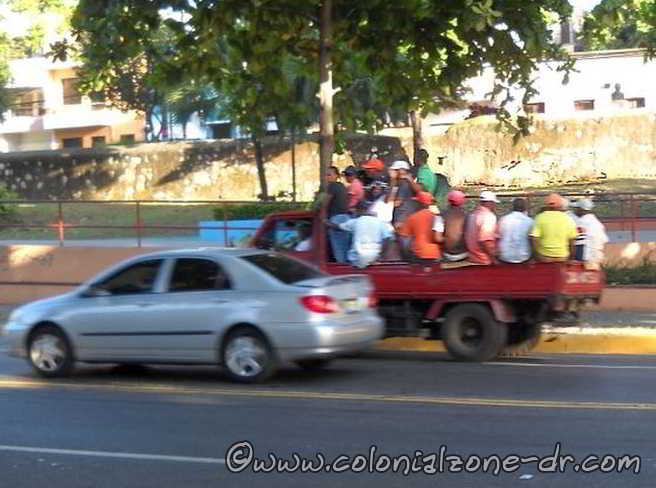
Pick-up truck taking people to work in the morning - another form of transportation in DR.
[TOP]
.jpg "A beat-up Public car")
Home | Transportation 1
Busses | Bus to Boca Chica | Taxi Services | Public cars | Guagua | Motoconchos | Car Rental | Driving Distances | Emergency Numbers | Air Transport | Carretera Juan Pablo II - Toll Highway | Airport Codes | Ports of Santo Domingo (Sans Souci / Don Diego) | Ferry Service | Horse and Buggy Rides | Metro of Santo Domingo - The Subway Line 1 and Line 2 | Subway Maps (including a Google map) | Dominican Travel Words (language pages) | Cámaras en vivo/ Live Cameras |
Would you like to take a Speed Boat ride? Go White Water River Rafting? Go Diving?
for these excursions and many others.


The cost for this mode of transportation can start at about $20 (1/14) pesos. Make sure to have the correct change as drivers usually do not give change.