
Dominican Republic Carnival Traditions
 
Traditions - Carnaval Dominicano - Carnival Dominican Style
[go to TOP of page]
Home | Traditions | You Are Here - Carnival
Search
This Site
Google
 
Web www.colonialzone-dr.com

Search this site powered by FreeFind
Copyright © 2005 - 2008 Colonial Zone-DR. All Rights Reserved.
US passports, only $99.  Same Day Service
Carnival is celebrated the entire month of Febrero/ February filling each weekend with parades, events and competitions. Each town offers their own twist to the event. The celebration climaxes on or near the 27th of February, Dominican Independence Day. It is an experience that everyone should have sometime in their life. Visitors and Dominicans alike wait with anticipation for this time of year. The celebration brings with it so much color and tradition from the vivid colors of the costumes, the spirited music and lively dancing. The droves and crowds of humans with voices raised. Experiencing the electricity (even if the electric power may be out) coming from the participants and viewers alike as all join in the festivities. Carnival  is a true Dominican experience.


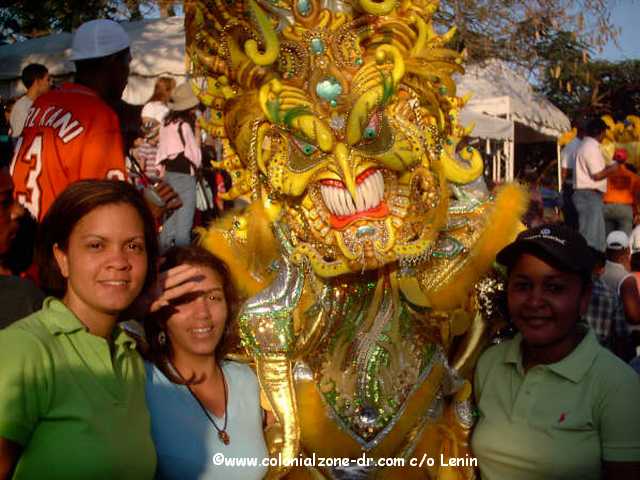
the colors of Dominican Republic carnival
Carnival Dominican style is a colorful and vibrant part of the culture here on the island of Hispanola in the country of Dominican Republic. Make sure to view all the great carnival pictures we have collected.
The use of masks to symbolize spiritual, supernatural and unknown spirit world entities has been used since before recorded history. Africa tribes and Native Americans, among the many ancient peoples, used masks to either depict, get the attention of , or to hide themselves from a higher, or more spiritual being. The natives of the island, the Tainos, and the natives of the surrounding islands had their own festivities long before the arrival of the Spaniards. Their celebrations were called areitos. Mainly they were to commemorate planting and harvest times. They also honored weddings, death and other significant happenings in their lives with these celebrations. They would use body decorations, tattoos, paint , jewelry, and masks during these festivals.  With the arrival of the Conquers and the African slaves they brought with them carnival celebrations evolved. The African peoples brought with them their own festivals and celebrations. These contributed the vibrant colors, and some of the traditions of making frightening masks, the musical instruments, dance and songs. They also gave a little humor to the mix by making fun of themselves and life. It was a way to escape the hardships of  life. Making their existence a little easier to bear by making jest of themselves and their circumstances.

Along with the arrival of Columbus and his entourage came European religion. Since carnival was mostly "pagan" the Spaniards added their religious inflections to the celebration. They wanted to permit their slaves let loose and  have a little diversion to get the wild out of their systems. Even though they said this was for the slaves and the natives of the island, the slave owners enjoyed the unrestrained festivities also.  To pacify their spiritual side, they had to add some religion into the mix.

Carnival has been celebrated in Santo Domingo since the mid 1500's and before. There is proof of carnival found in la Ruinas de la Vega Vieja/ Ruins of the Old Fertile Valley ( near the present day town of La Vega)showing that celebrations were going on  here even before they were celebrated in Santo Domingo. The people in the old town of La Vega disguised themselves as Moors and Christians (the Moors, the name the Spanish gave the Islamic persons, and Christians were always at odds.

It is thought that Dominican Republic was the first place in the Americas to observe the pre-Lenten carnival custom. The celebrations became an escape of the pressures and rigidity of religious tradition. By the late 1700's carnival had become a major celebration. Then when Dominican Republic won their independence February 27,1844 the celebration evolved to encompass the Independence Day commemorations as well. Finally, becoming what it is today.  Beginning the traditional carnival with  the pre-lenten celebrations, the climax concluding with the Independence Day observances. Combining both celebrations and making the entire month of February a celebration and time for enjoyment
+click image to enlarge
Colors of Carnival
picture/image crowds line the streets during carnival
Carnival is a country wide festival, with each  town having their own version of the custom. Every town adds a touch of their own flair to the merrymaking with diverse masks, costumes, characters, music and methods of celebrating. Even though there are many differences all the celebrations are charged with unbridled energy. Carnival is also very family orientated, having both young and old join in the festivities. Participating groups can consist of family units, clubs, friends, families and  businesses, all can participate in the carnival parade of masked creatures.
For more information on the names of these masked creatures go to the second page about Carnival.


Of the many costumes and creatures represented the most celebrated seem to be the devils known as Diablos Cojuelos. Others are painted bodies, or bodies decorated with paper. And yet others may have animal masks or elaborate costumes. Many disguises and get-ups symbolize the opposite, a world upside down. This is where the humor enters the scene. Men  may dress as women. All is the opposite of what one would expect. This can be very funny to observe. Some costumes represent the Indians or mock the dress of the conquerors  and oppressors of the island, the Europeans. These costumes  are a mix or all the cultures, beliefs, peoples and ideas, making for a unique viewing experience. The costumes are only limited by the imagination of the creator.

picture/image crying children watching carnival
It is enjoyable watching the children delighting in the carnival activities. Some are afraid and hide behind their parents. Some like to get dressed up in masks or paint their faces. They will mask themselves in whatever they have available. It is fun to see just how creative the children  can be when need dictates. The future generation of carnival parades are being spawned. (to see many more pictures of  Carnival - opens in new window)

The Carnival is very good for the economy bring in tourists by the droves. All coming to observe this spectacle. It helps the entrepreneurs with their home businesses creating masks and souvenirs that are all carnival orientated.  The mask makers, the trinket manufacturers, the food vendors, the transportation industry. All have a chance to make a nice profit during the month of February thanks to the
crowds line the streets during carnival
+click to enlarge
Children and adults watching carnival. Note the little boy crying.
Each troupe will represent different regions and towns throughout Dominican Republic. A town or bario will have  their own unique costumes  and customs. For many, each year the costumes must be different. Some burn their costumes after the carnival which represents change or closure, while others give their used costumes to the children. These costumes are widely diverse, some made of bright materials including satin and taffeta. Some are decorated with small round and square mirrors, bells, ribbons, whistles, tiny dolls. While others are fierce, repulsive and quite hideous. Many can bee very beautiful and elegant. There are men dressed as ladies, bodies covered in black grease, and other bodies brightly painted .
picture/image carnival cross-dressing
+click to enlarge
Carnival cross-dressing
Traditionally in the Colonial Zone, the night before Carnival, people lit their homes, balconies and streets. Illuminating the entire town. The boats would be decorated. There would be oranges and egg shells (more about the egg on the left of the page) filled with scented water, the hole plugged with wax. These were called ojos de cera/ wax eyes. They were thrown at the crowds. The procession was held on Calle el Conde.

The Carnival celebrations held in Santo Domingo at present bring troupes from the entire island together with a magnificent and  impressive parade held on the Malecon. The major competitions are held here with a nice sum of money to be won. The capital city is invaded with beings of all varieties, type and description. They are everywhere, roaming the streets. It is not easy many times to distinguish the parading beings from the beings watching the spectacle as many observers wear costumes also. You may see someone with toothpicks protruding from their hair. Diving from eggs (read more about the egg -across in the left margin) being thrown. Whips cracking. People yelling as they are hit by a masked creature on the back side. There will be debris littering the streets. People will have their faces painted. Children will have on plastic Halloween masks. There are all types of food being sold. Vendors selling their wares and trinkets commemorating the carnival. The sights and sounds of Dominican Carnival.
+click to enlarge
Carnival fun in La Vega

vejigas or bladder air filled balloons tradition
picture/image papar and rag costumed characters
vejigas for sale in the street
Carnival can be a very competitive pageant as there are prizes given for the best of the best in many different categories. With artist and participant working together to get the right fit and the look they desire. They can work all year making their costumes so they can join to celebrate and compete in this festival. Costume design and character presentations come together for the judging of the best groups in Carnival. The capital celebrations only permit up to 150 groups participating per region. Here the winners of the local Carnival events merge for this the grandest of  competitions. Original masks, costumes, floats and masked dance groups fuse to create a flood of activities in the streets. There can be than 50,000 parade participants joining in the Malecon parade in Santo Domingo with over half a million people that bombard the capital to watch and join in the carnival celebrations. All this is presided over by the King of the Carnival who is elected every year.
+click to enlarge
Paper and rag costumed paraders

The most popular Carnival activities are in the town of  La Vega. Normally a very quiet town with not much tourists draw. Durning carnival here is where thousands of people go every Saturday and Sunday during the month of February. People gather on Calle Padre Adolfo (with the cathedral lurking in the distance), in front of the Parque de las Flores or  to watch the spectacular event.  The registered groups, known as comparsas, participate in the Carnival parade. These groups can be well organized. Many
Amongst all the colors, activity and music in abundance one must always be on high alert for the vejigas/ the inflated bladder weapons and the látigos/ whips. The vejigas are a balloon type weapon dangling at the end of a strap, toted by these wicked creatures. These balls are traditionally made of either cow or pig bladders and filled with air. They are also sometimes made of rubber these days. These are used to hit the people that happen to get in the way. Always aiming to hit on the lower part of the body but with all the commotion in the street it is a free for all. Originally these balls were used as crowd control to make way for the costumed peoples. It is said that getting hit brings good luck. I think it is more lucky if you can avoid being hit. I suggest staying away from these weapon-bearing creatures because getting hit hurts. Getting wapped in the butt is not pleasant but it is all part of the Carnival experience.

During most carnival celebrations the la Cámara de Diputados y el Patrimonio Folklórico de la Nación/ The House of Representatives and the Folkloric Patrimony of the Nation set limitations for the safety of all involved, paraders and observers alike. Prohibited are firearms, glass bottles and any knife/machete type weapon. Also they watch closely to make sure the vejigas are within the limits that have been set forth. No sharp edges or objects attached. They cannot be inflated to be to hard.  They try to make the carnival safe and fun for all.
Warning, do not try and block the hit if you see it coming. Just turn your butt to the weapon and let it hit there. It hurts much less on the back side than it does on the hand and other areas of the body.
Continue on for descriptions of the Carnival Creatures and beings on the next page.....

For many more pictures of Carnival Dominicano go to our Carnival picture page here. Enjoy the slide show.
Continue reading about the carnival
Carnevale in Greek is pronounced Aprokies and it means "farewell to meat".

I have been reading up on different carnival traditions throughout the world and it is very surpriseing how many of them are similar.

The Egg: The Romans phrase Omne vivum ex ovo, "All life comes from an egg." The egg is a universal symbol of birth and resurrection. It has been used by many cultures. The Egyptians and Greeks used eggs in their burial rituals. Mexico fills eggs (cascarones) with confetti or small prizes and throws them. Early variations, connected with the customarily riotous pre-Lenten celebrations, were filled with either perfumed or nasty-smelling colored water and sealed with a plug of wax.
Many countries celebrate some type of Carnival. There are a multitude of different names as there are varieties of traditions that follow this custom.
Mardi Gras (Fat Tuesday)- New Orleans, USA
Jamaica Carnival - Jamaica
Carnival of Binche - Belgium
Trinidad Carnival - Port of Spain, Trinidad
Carnival St. Thomas - US Virgin Islands
Nice Carnaval - French Riviera, France
Carnival of Venice - Italy
Carnival - Rio de Janeiro, Brazil
Carnival (Fastnacht) in Cologne - Cologne, Germany
Maslenitsa - Russian Carnival
Zapusty - Poland
Fore more information: http://www.caribbean-dominican-republic.com/ carnaval_origins.htm
IMPORTANT STUFF/EVERYTHING ELSE

have participated together for many years. The groups may include from 10 to 15 people and sometimes many more. The traditional costumes are carefully sewn months in advance and are very intricate and colorful.
Marriage | Funeral | New Years | Christmas | Carnival | Carnival Characters | Town Traditions | I just made the 2008 Carnival Slide show (3/4/08). check it out
icture/image crying children watching carnival
The original Latin word "carne vale," means farewell to meat.
html Site Map


ARTISTS
BOOKS
FOOD and RECIPES
HELPS/ HINTS/ PUDDLES
HISTORY
DOMINICANISMOS
LANGUAGE
MUSIC
MAGAZINES
NEWS PAPERS
TELEVISION STATIONS
RADIO STATIONS
PASTIMES and THINGS TO DO
PRODUCTS
TRADITIONS
MYTHS and LEGENDS
SUPERSTITIONS
EVERYTHING ELSE
LINKS
ABOUT US
SUN-N-MOON JEWELRY


MENU
IN COLONIAL ZONE
THINGS DOMINICAN
THE DR-GRINGA'S LIFE BLOG
Real Life and Times in the Dominican Republic

Add Us To Your Favorites!


Our complete exchange rate tool can be found here
Gracias a coinmill.com
Free cell phones. Great rate plans.
Get Premium Tickets at TicketsNow
HOTELS
BARS &
RESTAURANTS
OTHER EATERIES
SIGHT SEEING
PICTURES
BUSINESSES
HOME
CALENDAR
EVENTS
TRANSPORTATION
WEATHER
MAPS
MAP OF COLONIAL ZONE
HOT SPOTS!
Home | Calendar | Events | Transportation | Maps | Hotel | Night Life & Dining | Sight Seeing | Pictures | Businesses | Artists | Food | Helps | History | Language | Music | News | Pastimes | Products | Traditions/Legends | Links | About Us-Contact | Sun-N-Moon Jewelry | Chat | Web Designers Info |
Free Spanish Lessons
Important Stuff | Traditions | Dominican Republic Facts | Environmental Issues | Myths and Legends | Superstitions | National Songs | Religious Beliefs | Charities | Creatures | Trivia and Useless Facts | Live Cameras/ Camaras en Vivo | Public Services |
Click for Santo Domingo, Dominican Republic Forecast
Home | Dining & Night Life | Hotel | Sights | Pictures | Chat | Colonial Zone Map | Hot Spots! |
banner
logo
We Have a Chat Box.
Talk To Us!
carnival. Mask makers can start creating as soon as carnival is over, preparing and designing for the following year. Readying a town for carnival usually starts immediately after the Christmas celebrations. Getting all ready to make money for the town and its people and to have a good time.
The most popular Carnival celebrations are:
*Carnaval Vegano - Carnival in La Vega - This is thought to be the oldest carnival celebration in the Americas. Held in the center of this small town on Calle Duarte starting at the church.
*Carnaval Bonao - La “Villa de las Hortensias” held in the Parque Central
*Carnaval Santiago. This huge carnival is held on the streets Las Carreras, Beller and Francia
*Carnival Santo Domingo - The capital city has the grand finale carnival parade. This year (2008) they are trying something new holding parades each Sunday throughout February.

No matter where one goes to see Carnival it is a true fusion of culture and religion Dominican style. Always a grand blend of colors, music, wild activities and exciting dances. The Diablos Cojuelos come out into the streets swinging their weapons and cracking their whips. The people are enjoying. It is an audience participation parade in grand scale. Something that all should experience sometime in their lives.
Skype - call the world at rock bottom prices